 |
| First English translation of Hegel's Science of Logic (1929). |
Showing posts with label Self-consciousness. Show all posts
Showing posts with label Self-consciousness. Show all posts
Sunday, 25 September 2022
Hegel on the Concept in General (Part Two)

Friday, 31 December 2021
Jean Wahl and Hegel-scholarship in the Age of Existentialism (Part Two)
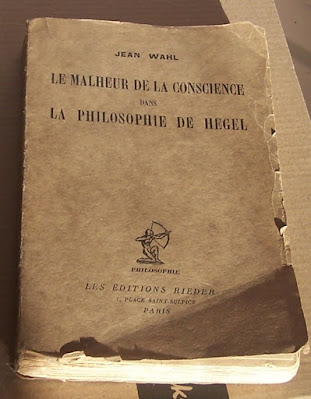 |
| The first edition of Wahl's book on Hegel (1929). |
This post completes our discussion of French philosopher Jean Wahl's Le Malheur de la conscience dans la philosophie de Hegel [The Misfortune of Consciousness in Hegel's Philosophy] (1929). We outline the reception of the idea of "unhappy consciousness" which is central to Wahl's interpretation of Hegel and then evaluate his understanding of the idea.
Tuesday, 31 December 2019
The Skeptical Origin of the Divided Consciousness
 |
| The collection Between Kant and Hegel (1985) contains Hegel's essay on skepticism in English translation. |
Monday, 1 July 2019
Hegel and Jacobi on Skepticism and Christianity
 |
| Portrait of F.H. Jacobi (1743-1819), by Johann Friedrich Eich, 1780. |
Saturday, 28 July 2012
John Macmurray’s Early Milieu

This post reproduces Stephen Cowley's article in the John Macmurray Fellowship Newsletter 24 (2009). The article relates some central ideas of the personalist philosopher John Macmurray (1891-1976) to those of his British Idealist teachers in Glasgow (see photo above, from Kelvingrove Park) and Oxford. The Idealist movement flourished in Victorian and early 20th century Britain, seeking to develop ideas drawn from Kant and Hegel by way of a critique of contemporary empiricist and scientific thought on society and the nature of the mind.
The John Macmurray Fellowship website can be found here.
The John Macmurray Fellowship website can be found here.
Subscribe to:
Posts (Atom)