Showing posts with label Herbart. Show all posts

Saturday, 20 September 2014

Herbart's Psychology


This post summarises Herbart's contributions to philosophical psychology and his critique of Fichte's Idealism. The contrast with Hegel comes out particularly in their differing responses to Fichte. We draw from Marcel Mauxion's La Métaphysique de Herbart (1894). Above is an image of Herbart's Psychology as a Science (1824-25). We conclude our series of posts on Herbart with a link to a remarkable piano sonata which he composed in 1808.

Wednesday, 10 September 2014

Herbart's Philosophy of Religion

This post discusses Herbart's religious philosophy. We use Marcel Mauxion's La Métaphysique de Herbart (1894). The above picture shows the old university of Königsberg with the Cathedral in the background of the Dominsel (Cathedral island).

Sunday, 7 September 2014

Herbart's Philosophy of Nature


This post summarizes Herbart's philosophy of nature. Herbart shared the project of a philosophical understanding of nature distinct though complementary in its aims and method from natural science with his contemporaries Schelling and Hegel. This is not now a common project. We draw for our account on Marcel Mauxion's La Métaphysique de Herbart (1894). The above image is of the Herbartdenkmal in Oldenburg around 1900.

Saturday, 30 August 2014

Herbart's Theory of Being


This post outlines Herbart's account of being, which is characterized by the credence given to metaphysical analysis in a Leibnizian vein and the critique of Fichte’s idea of the “self creation of man”. We draw for our account on Marcel Mauxion's La Métaphysique de Herbart (1894). Above is an extract from the manuscript of Leibniz's Monadology.

Wednesday, 27 August 2014

Herbart on Metaphysics and Method


This post continues on from our biography of Hegel's contemporary Herbart and discusses his general view of metaphysics and method. We use Mauxion's La Métaphysique de Herbart (1894). The above is a picture of Old Königsberg, the former capital of East Prussia, where Herbart lectured as successor of Kant.

Sunday, 27 July 2014

Herbart and Hegel (Part One)


This post covers the biography and principal writings of Hegel's realist contemporary, Johann Friedrich Herbart (1776-1841). It begins a short series of posts aiming to shed light on the intellectual possibilities of Hegel's time and place through comparison with the contrasting ideas of Herbart.

Sunday, 21 July 2013

Hegel's late critical essays


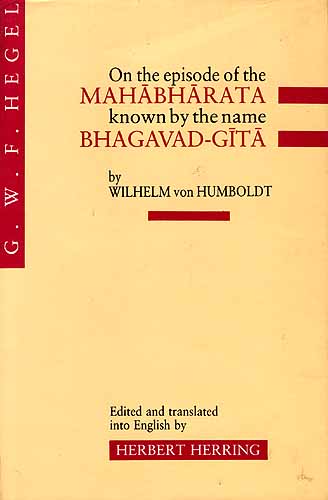
This post summarises Hegel's part in the founding of the Annual for Scientific Criticism in Berlin and the articles he wrote for it. The first of these (English translation above) addressed the story of Arjuna from the Indian dialogue in the Bhagavad Gita. The material is drawn principally from Karl Rosenkranz's Hegels Leben (1844).

Sunday, 16 December 2012

Hegel in Berlin (Part One)


This post is the first of several, dealing with Hegel's time in Berlin from 1818 to 1831. The material is drawn from Karl Rosenkranz's Life of Hegel (1844), the first biography of Hegel. During this time Hegel taught at Berlin University and was involved in the development of Prussian politics, culture and society. Many of his posthumously published lectures date from this period, during which his original works included the Philosophy of Right (1821), the second and third editions of his Encyclopaedia of Philosophical Sciences (1827, 1830) and some notable contributions to journals.

Wednesday, 29 August 2012

Hegel in Nuremberg


This post covers my reading of Hegel's period at Nürnberg, including his rectorship at the Aegidiengymnasium and marriage, drawn again from Book II of Karl Rosenkranz's Hegels Leben (1844). I will reserve comments on the Science of Logic for a separate post.